Alright, let's dive into this Zcash surge. The headlines are screaming that it's back, hitting prices not seen since 2018 and breaking into the top 20 cryptos. But is this a real resurgence driven by "cypherpunk principles," as Galaxy Digital suggests, or just another altcoin pump fueled by the renewed interest in privacy after the crackdown on Bitcoin privacy tools? My job is to sift through the noise and give you the unvarnished truth.
First, the raw numbers are impressive. A 1,270% year-over-year gain is nothing to sneeze at. We're talking about a market cap pushing $10 billion. Daily trading volume has jumped to $1.8 billion, spread across major exchanges. That's real liquidity.
But let's not get carried away. The article points out that Zcash is being positioned as an "encrypted Bitcoin," a return to cypherpunk ideals. The argument is that Bitcoin ETFs are making the original crypto more centralized and subject to surveillance. Zcash, with its shielded transactions, offers a privacy-focused alternative. Zcash Surging on 'Cypherpunk Principles' as Bitcoin Alternative: Galaxy Digital
Here's where my skepticism kicks in. While Zcash does share some design elements with Bitcoin—a 21 million supply cap and a proof-of-work consensus model—the reality is that shielded transactions are optional. And this is the part of the report that I find genuinely puzzling. How many users are actually using the shielding feature? Are we talking about a niche within a niche? The article notes that 30% of the Zcash supply has become shielded. That's a decent chunk, but what's the trend? Is it growing, stagnating, or declining? Without that data, it's hard to say if the privacy narrative is truly driving adoption or if it's just marketing spin.
The data suggests it’s not just leverage. The spot-to-futures ratio is high, with $801 million in 24-hour spot volume versus $4.5 billion in futures turnover. This indicates organic demand is contributing to the price movement (or at least more than the usual crypto casino).
However, let's not ignore the futures market entirely. Open interest on Binance is around $340 million, followed by Hyperliquid at $332 million, and Bybit at $157 million. The long-short ratios are hovering around parity. So, while it's not a speculative mania, there's still a significant amount of leveraged trading happening. It's like a tug-of-war.
The article also mentions the rising popularity of the Zashi wallet and forthcoming developments under Project Tachyon. These are potential catalysts, but we need to see concrete results. Wallets are a dime a dozen in crypto and "forthcoming developments" are, more often than not, vaporware.
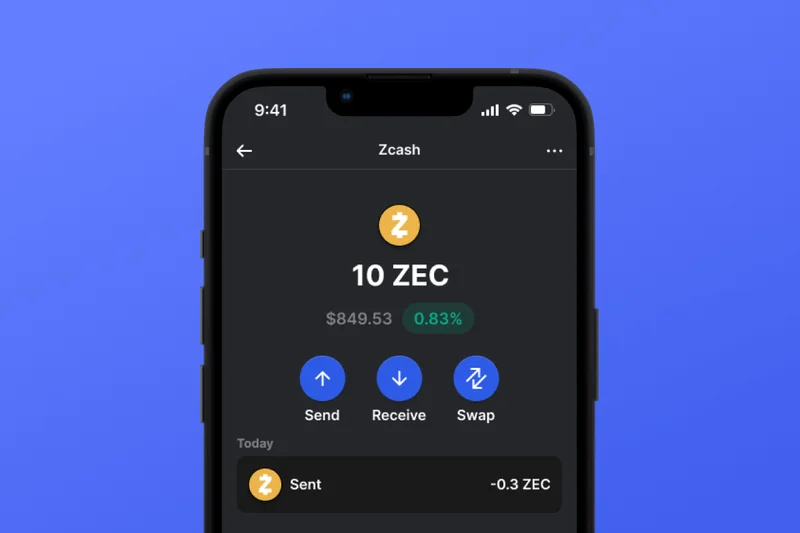
Here's my biggest issue with the current narrative: it's too focused on price action and not enough on actual usage. We need data on the number of active shielded addresses, the average transaction size, and the overall volume of shielded transactions. How does Zcash privacy compare to other privacy coins like Monero? What are the gas fees (or equivalent) for shielded transactions? Are they prohibitively expensive for the average user?
I've looked at hundreds of these filings, and the lack of detailed on-chain data is frustrating. It's like trying to analyze a company's financial performance without access to their balance sheet. You can look at the stock price all day long, but it won't tell you the whole story.
Zcash's advocates frame it as "encrypted Bitcoin," a return to cypherpunk principles. But is that resonating with the broader market? Or is it just a talking point for a small group of crypto enthusiasts?
The crackdown on Bitcoin privacy tools like CoinJoin services is definitely creating a vacuum. The Samourai Wallet founders facing maximum sentences and Wasabi Wallet banning U.S. customers—that's significant. It creates an opening for privacy-focused alternatives like Zcash.
But, and this is a big but, Zcash isn't the only option. Monero is a major competitor, and other privacy coins like Dash and Decred are also seeing renewed interest. Zcash's market cap of $6.5 billion puts it slightly ahead of Monero ($6.44 billion) and Litecoin ($6.43 billion), but the competition is fierce. Zcash Price Analysis: Breaks Into Top-20 Cryptos, Hits $600 for First Time Since 2018
So, where does that leave us? Zcash is definitely having a moment. The price surge is real, and it's not entirely driven by speculation. There's genuine interest in privacy-focused alternatives to Bitcoin, and Zcash is well-positioned to capitalize on that trend.
But before you go all-in, remember that the crypto market is notoriously volatile. And the lack of comprehensive on-chain data makes it difficult to assess the long-term viability of Zcash.
The hype is real, but the substance needs more scrutiny. Until we see more data on actual shielded transaction usage and a clearer picture of Zcash's competitive advantage, it's wise to remain cautiously optimistic.