# Rivian's Electrifying Comeback: Why Q3 Isn't Just a Bounce, It's a Blueprint for the Future of Adventure EVs
When I first saw the Q3 numbers roll in for Rivian, I honestly just sat back in my chair, speechless. For years, the story has been one of audacious vision battling brutal reality, a high-flying startup struggling to find its footing on the unforgiving ground of manufacturing. But what we just witnessed in Rivian's latest earnings report isn't just a modest improvement; it feels like the ignition of a rocket that's finally achieved escape velocity. This isn't just about a stock price ticking up; it's about a fundamental shift, a blueprint emerging for how a truly innovative EV company can not only survive but thrive and redefine a segment.
Let's cut right to the chase, because the data is screaming a new narrative. Rivian produced over 10,700 vehicles and sold more than 13,200 in Q3 2025. That's a serious acceleration. Revenue surged by a whopping 78% year-over-year, hitting $1.56 billion. But here’s the real kicker, the one that makes every engineer and business strategist sit up straight: Rivian turned a gross profit of $24 million. For those of you who aren't knee-deep in financial statements, let me clarify: "gross profit positive" means they're finally making money on each vehicle they build before accounting for overheads like R&D and marketing. This isn't some accounting trick; it’s proof that their manufacturing process is maturing, their costs are coming down, and their unit economics are finally clicking into place.
This positive gross profit is a monumental achievement, especially after two consecutive quarters of losses at that level. It’s the kind of milestone that separates the dreamers from the doers, the startups from the sustainable enterprises. Sure, the net loss still sits at $1.16 billion, reflecting ongoing investments, but that positive gross profit is like finding bedrock after years of digging in quicksand. It provides a foundation. And the market? It responded with a 23% surge in the stock, pushing it to $13.35. More tellingly, Citigroup, a major institutional player, more than doubled its stake in Rivian, now holding nearly $125 million worth of shares. That’s not a speculative gamble; that’s a calculated bet on a company turning a corner. It makes you wonder: with this kind of institutional validation, how long until the broader market truly catches up to what's brewing here?
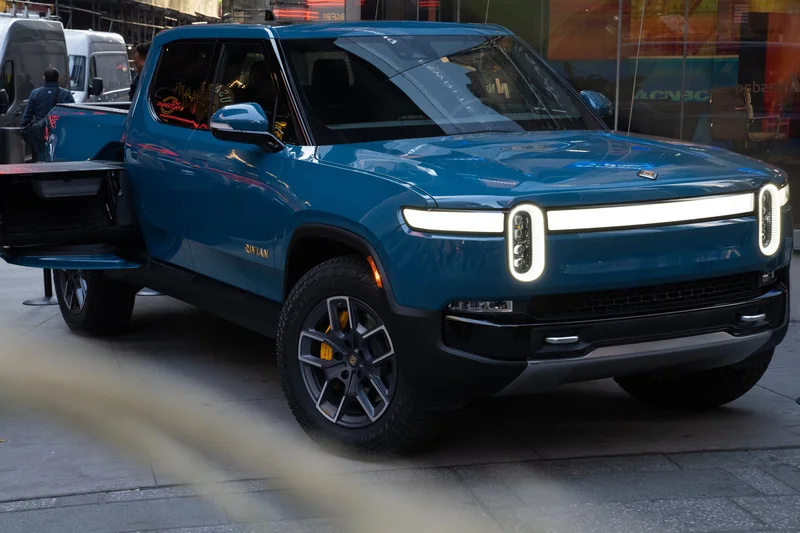
But the Q3 report isn't just a story about internal optimization; it's about external validation that could redraw the entire EV landscape. Enter Volkswagen. The deepening partnership with VW, involving an initial $1 billion investment scaling to a staggering $5.8 billion, isn't just a cash infusion. It's a profound endorsement of Rivian’s core technology. VW isn't just buying vehicles; they're integrating Rivian’s EV architecture and software into their own models starting in 2027. This is like Intel inside, but for the soul of an electric vehicle. Rivian isn't just building adventure trucks; it's building the brains and bones that could power a significant portion of the global EV fleet.
Imagine the implications! This isn't just about Rivian selling more trucks; it’s about Rivian becoming a foundational technology provider, a silent partner in the electrification of legacy automakers. This is a game-changer for scale, for influence, and for validating their engineering prowess. It’s a thought leap, really, akin to how Microsoft's operating system became the backbone for countless PCs, or how ARM architecture powers billions of smartphones. Rivian is positioning itself to be a critical enabler, not just a competitor. And with great power comes great responsibility, of course. It forces us to consider the ethical implications of such a widespread technological footprint: how will they ensure sustainability, data privacy, and equitable access as their architecture becomes a global standard? It's a monumental opportunity, but also a profound challenge to wield that influence thoughtfully.
The road ahead is clearer than ever. Rivian is expanding its Illinois facility and building a massive new plant in Georgia, targeting a combined capacity of over 600,000 units by 2028. This isn't for the R1T and R1S alone, brilliant as they are. This is for the R2. The R2 SUV, priced at a highly competitive $45,000 and aiming for a bill of materials around $32,000, is their true foray into the mass market. This is where the adventure EV, the one that cracked the template for the electric pickup when Tesla was still showing off a trapezoid, truly breaks free. Forget the naysayers who called Rivian "a dog of a company" during its lean years; they were looking at the dog in the hunt, not the wolf leading the pack into a new frontier. This R2 launch, coupled with the VW partnership and the increasingly efficient production, means Rivian is not just aiming to compete with the Model Ys and Mustang Mach-Es of the world; it’s aiming to define the next generation of accessible, capable, and genuinely exciting electric vehicles, and it’s doing it with a clear path to profitability and unprecedented strategic partnerships that are just, well, electrifying to watch unfold.
What we’re seeing isn't just a recovery; it's a redefinition. Rivian has navigated the brutal gauntlet of startup manufacturing, learned hard lessons, and emerged stronger, smarter, and with a strategic alliance that could make it an indispensable player in the global EV transition. This isn't just a stock bounce; it's the dawning of a new era for adventure EVs, built on a foundation of solid engineering and smart partnerships. Can they maintain this momentum, balance rapid growth with their unique brand identity, and truly deliver on the promise of that $45,000 R2? The blueprint is laid, the engine is humming, and for the first time in a long time, the path ahead looks incredibly bright.